Showing posts with label Ohio. Show all posts

Monday, June 20, 2016

Elder Abuse Day exposed at Healthy Exchange

Elder Abuse Day exposed at Healthy Exchange


By Portia Williams - portiawilliams@civitasmedia.com


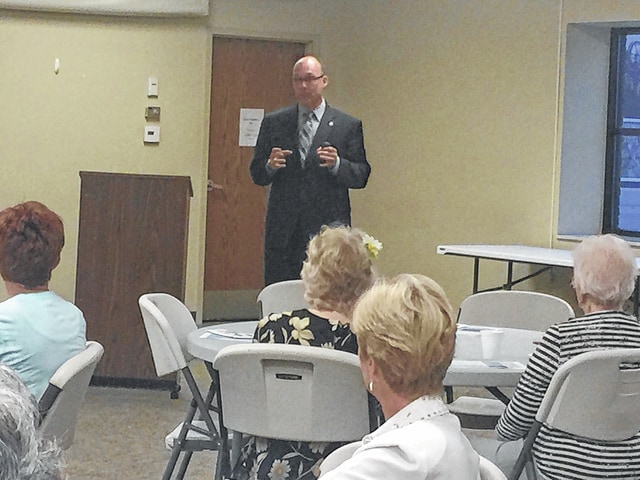
Portia Williams | Daily Times Chief of Police Rob Ware spoke on financial exploitation of elders at the SOMC Healthy Exchange held at the Portsmouth Welcome Center Wednesday.
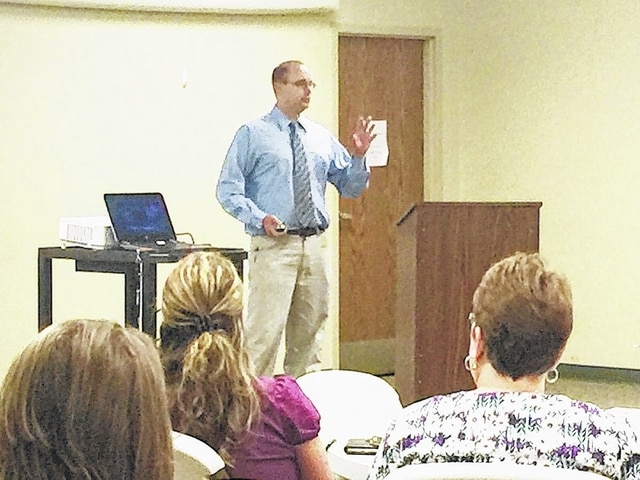
Portia Williams | Daily Times Dr. Ron Miller of SOMC spoke about elder abuse at the SOMC Healthy Exchange held at the Portsmouth Welcome Center Wednesday.
Portia Williams | Daily Times Left to right: Abigail Puckett, Kristen Wawro teacher at East Sciotoville Community Schools (ESCS), and Jonas Cooper. Both Puckett and Cooper are students at ESCS.
Wednesday, June 15 was World Elder Abuse Awareness Day. Southern Ohio Medical Center ( SOMC) worked in conjunction with Portsmouth Chamber of Commerce to host a Healthy Exchange session with Dr. Ron Miller of SOMC and Portsmouth Police Chief Rob Ware as guest speakers.
As cases of elder abuse continue to increase, Miller, Emergency Medical Program director of SOMC, and Portsmouth Chief of Police Rob Ware, dispensed a wealth of knowledge and information use to combat the growing problem in the local community at the Welcome Center. Miller said the basis of his presentation was the level of impact elder abuse has upon the local community.
“We discussed the issue of elder abuse, and its level of impact upon our community, and the impact that it will have as our population ages,” Miller said. “We talked about the different types of elder abuse that are prevalent in our community, and how we can help them. Mostly, it is to shine a light on the problem, most people know that it is there, and that it is a problem, but then as a group we can start formulating a plan on how to fix it.
Ware spoke extensively about avoiding financial exploitation. He said the sooner the signs of elder abuse are detected, the better elders are in the long run.
“I think that it is critically important that we educate the public on the signs of elder abuse,” Ware said. “As I stated before, things fly under the radar and are so subtle, that if you don’t have the professional community looking out for elders, is of the utmost important. The sooner we notice and know how to detect the signs, the sooner we are able to catch the culprits, before the life savings of an elder is wiped out.”
At the conclusion of the presentations Ware recognized and presented award the winning students of a local essay contest that was held by the Scioto County Elder Abuse Task Force. The students were asked to write about an elderly adult who has made a difference in their life, what they were able to learn from that particular adult and what they do for them to show appreciation.
The first place winner of the essay contest was Jonas Cooper who wrote about his grandfather. Cooper received a $100 gift car. Second place was Abigail Puckett, who wrote about her grandmother. Puckett received a $50 gift card. Both Cooper and Puckett are junior high school students at East Portsmouth Elementary School, and their teacher is Kristen Wawro.
Wawro, said both Cooper and Puckett are talented students who she is proud of.
“They are both very good writers, and it is really nice for them to write about people that are extremely important to them, and I am very proud of their accomplishments,”Wawro said.
Hope Blizzard, medical staff liaison of SOMC, said discussing elder abuse is critical.
“I think that it is very important to bring to light the issue of elder abuse and financial abuse and the different types of elder abuse in the world,” Blizzard said. “I also admire how this younger generation is coming up, and all of the positive things that they are learning from their elders so I think it was a happy end

Portia Williams | Daily Times Chief of Police Rob Ware spoke on financial exploitation of elders at the SOMC Healthy Exchange held at the Portsmouth Welcome Center Wednesday.
http://portsmouth-dailytimes.com/wp-content/uploads/2016/06/web1_Chief.jpgPortia Williams | Daily Times Chief of Police Rob Ware spoke on financial exploitation of elders at the SOMC Healthy Exchange held at the Portsmouth Welcome Center Wednesday.

Portia Williams | Daily Times Dr. Ron Miller of SOMC spoke about elder abuse at the SOMC Healthy Exchange held at the Portsmouth Welcome Center Wednesday.
http://portsmouth-dailytimes.com/wp-content/uploads/2016/06/web1_Dr.Miller.jpgPortia Williams | Daily Times Dr. Ron Miller of SOMC spoke about elder abuse at the SOMC Healthy Exchange held at the Portsmouth Welcome Center Wednesday.

Portia Williams | Daily Times Left to right: Abigail Puckett, Kristen Wawro teacher at East Sciotoville Community Schools (ESCS), and Jonas Cooper. Both Puckett and Cooper are students at ESCS.
http://portsmouth-dailytimes.com/wp-content/uploads/2016/06/web1_Winners.jpgPortia Williams | Daily Times Left to right: Abigail Puckett, Kristen Wawro teacher at East Sciotoville Community Schools (ESCS), and Jonas Cooper. Both Puckett and Cooper are students at ESCS.
By Portia Williams
portiawilliams@civitasmedia.com

Reach Portia Williams at 740-353-3101, ext. 1929, or on Twitter @PortiaWillPDT.

Reach Portia Williams at 740-353-3101, ext. 1929, or on Twitter @PortiaWillPDT.

Friday, May 6, 2016

Probate judges do not have authority to issue search warrants on criminal matters.

[Cite as State v. Brown, 142 Ohio St.3d 92, 2015-Ohio-486.] THE STATE OF OHIO, APPELLANT, v. BROWN, APPELLEE. THE STATE OF OHIO, APPELLANT, v. SHIPLEY, APPELLEE. THE STATE OF OHIO, APPELLANT, v. MCCLOUDE, APPELLEE. [Cite as State v. Brown, 142 Ohio St.3d 92, 2015-Ohio-486.] Probate judges do not have authority to issue search warrants on criminal matters. (Nos. 2013-1110, 2013-1111, and 2013-1112—Submitted June 10, 2014— Decided February 18, 2015.) APPEALS from the Court of Appeals for Stark County, Nos. 2012CA00099, 2013- Ohio-2224; 2012CA00100, 2013-Ohio-2225; and 2012CA00101, 2013-Ohio-2226. _______________________ O’NEILL, J. {¶ 1} In these three cases, we are asked to determine whether probate judges have the authority to issue search warrants on criminal matters. We hold that they do not. Unless a probate judge has been assigned by the chief justice pursuant to Article IV, Section 5(A)(3) of the Ohio Constitution to temporarily sit or hold court in another division of a court of common pleas, a probate judge does not have the authority to hear evidence and issue search warrants in criminal matters. {¶ 2} These cases arise out of the same set of facts and raise the identical issue, so we consolidated the cases for oral argument, and we now consolidate the cases for decision. Facts and Procedural History {¶ 3} There is no dispute among the parties regarding the facts underlying these cases. In February 2012, a detective with the Alliance Police Department obtained a search warrant from a judge of the Stark County Court of SUPREME COURT OF OHIO 2 Common Pleas, Probate Division. The warrant gave law enforcement permission to search a business in Alliance for evidence of illegal gambling. Pursuant to that warrant, more than 30 video slot machines were confiscated, giving rise to charges filed against defendants-appellees, Todd Brown (case No. 2013-1110), Jeff Shipley (case No. 2013-1111), and Raymond McCloude (case No. 2013- 1112), who were operating the business. {¶ 4} Appellees filed motions to suppress the evidence obtained during the search, arguing that the search warrant was void because probate judges do not have the statutory authority under R.C. 2933.21 to issue a criminal search warrant. As a result, appellees asserted, the evidence seized during the search was the fruit of an unconstitutional search under the Fourth Amendment. {¶ 5} The cases were all pending before the same municipal court judge, and the cases were consolidated for purposes of the hearing on the motions to suppress. The trial court agreed that the warrant was unlawful and granted the motions to suppress the evidence gathered pursuant to the tainted warrant. {¶ 6} The state filed an appeal in each case, and the Fifth District Court of Appeals affirmed the trial court judgments as to a probate judge’s lack of authority to issue a search warrant. However, the appellate court reversed the judgments granting the motions to suppress the evidence, finding that the state had established that the police officers had acted in good-faith reliance on the warrant under United States v. Leon, 468 U.S. 897, 104 S.Ct. 3405, 82 L.Ed.2d 677 (1984). The state appealed the judgment in each case to this court, asserting a single proposition of law in each: “A ‘probate judge’ has the authority as a division of the Ohio Court of Common Pleas to hear evidence and issue search warrants on criminal matters within [his or her] territorial jurisdiction.” The Unlawful Warrant {¶ 7} Because this case involves only a question of law, our review is de novo. In re J.V., 134 Ohio St.3d 1, 2012-Ohio-4961, 979 N.E.2d 1203, ¶ 3. January Term, 2015 3 {¶ 8} R.C. 2933.21 states, “A judge of a court of record may, within his jurisdiction, issue warrants to search a house or place * * *.” Crim.R. 41(A)(1) states, “A search warrant authorized by this rule may be issued by a judge of a court of record to search and seize property located within the court’s territorial jurisdiction.” And R.C. 2931.01 provides, “As used in Chapters 2931 to 2953 of the Revised Code: * * * (B) ‘Judge’ does not include the probate judge [and] (C) ‘Court’ does not include the probate court.” Plainly, pursuant to the Ohio Revised Code, a probate judge does not have the authority to issue a search warrant in a criminal case. {¶ 9} This court recognized an exception to the statute in cases where the chief justice, pursuant to Article IV, Section 5(A)(3) of the Ohio Constitution, assigns a probate judge to temporarily sit or hold court on any other division of a court of common pleas. State v. Cotton, 56 Ohio St.2d 8, 12-13, 381 N.E.2d 190 (1978). However, no such assignment was made in these cases. Accordingly, the exception does not apply. {¶ 10} The state admits that the plain language of R.C. 2931.01 excludes probate judges from the definition of “judge” for purposes of R.C. Chapters 2931 to 2953. The state suggests that this statute was “missed or improperly recodified” when the Modern Courts Amendment to the Ohio Constitution was adopted by voters. The amendment made the probate court a division of the common pleas court. The state’s supposition may be true, however, more than 45 years have passed since the 1968 Modern Courts Amendment. Even in legislative time, 45 years is long enough to correct an error. Moreover, unless the court first makes a determination that the language of the statute is capable of more than one meaning, it is inappropriate to examine legislative history, legislative intent, public policy, or any other factors to determine the meaning of a statute. Dunbar v. State, 136 Ohio St.3d 181, 2013-Ohio-2163, 992 N.E.2d 1111, ¶ 16. The language of the statute is plain and unambiguous. Thus, we decline to ignore the SUPREME COURT OF OHIO 4 plain language of the statute to embrace the state’s supposition. We hold that unless appointed by the chief justice pursuant to Article IV, Section 5(A)(3) of the Ohio Constitution, a probate judge does not have the authority to issue search warrants in criminal matters. Exclusion of the Evidence Obtained in Executing an Unlawful Search Warrant {¶ 11} We agree with the Fifth District that the good-faith exception to the exclusionary rule set forth in Leon, 468 U.S. 897, 104 S.Ct. 3405, 82 L.Ed.2d 677, applies in these cases. Although no party appealed from this portion of the Fifth District’s judgments, we address it here for clarity. {¶ 12} The exclusionary rule is a judicially created sanction designed to protect Fourth Amendment rights through its deterrent effect. Id. at 906. Under the rule, the state is precluded from using evidence obtained in violation of the Fourth Amendment. But unbending application of the exclusionary rule “ ‘would impede unacceptably the truth-finding functions of judge and jury.’ ” Id. at 907, quoting United States v. Payner, 447 U.S. 727, 734, 100 S.Ct. 2439, 65 L.Ed.2d 468 (1980). “[W]hen law enforcement officers have acted in objective good faith or their transgressions have been minor, the magnitude of the benefit conferred on such guilty defendants offends basic concepts of the criminal justice system.” Id. at 908. For this reason, the Supreme Court of the United States determined that the exclusionary rule should not be applied to bar evidence obtained by officers acting in reasonable good-faith reliance on a search warrant issued by a detached and neutral magistrate that is ultimately found to be unlawful. Id. at 905-925. Accordingly the court of appeals’ rulings that the evidence would not be suppressed, which were not appealed from, remain the law of the cases. {¶ 13} The judgments of the appellate court holding that probate judges do not have authority to issue search warrants on criminal matters are affirmed, January Term, 2015 5 and the matters are remanded to the trial court for further proceedings consistent with this opinion. Judgments affirmed and causes remanded. O’CONNOR, C.J., and PFEIFER and LANZINGER, JJ., concur. O’DONNELL, KENNEDY, and FRENCH, JJ., concur in judgment only. ___________________ Jennifer L. Arnold, Alliance Law Director, for appellant

Tuesday, December 8, 2015

Restitution for wards may be long fight

Restitution for wards may be long fight


By The Columbus Dispatch  • 
  •  34
  •  98
Enlarge Image Request to buy this photo
Brooke LaValley | Dispatch file photo
Lawyer Paul S. Kormanik
When news of Paul Kormanik’s death reached Phil Metoyer, there was no watershed moment.
No feeling of relief.
No justice.
On many nights, Metoyer had thought about what he’d say to Kormanik, a lawyer who had been appointed as guardian to Metoyer’s father, Albert.
In his final years, Albert Metoyer lacked proper medical care because Kormanik failed to file the right paperwork to enroll him for Medicaid, according to Franklin County Probate Court records. Kormanik liquidated the man’s assets and even interfered with the family’s plans for funeral arrangements.
It has been six weeks since Kormanik was found dead in his Upper Arlington home — the same morning that the longtime lawyer and guardian was supposed to appear in Probate Court on contempt charges for failure to pay restitution to a ward he had victimized.
Attorneys and friends close to the Kormanik family said he died by suicide. Official autopsy results are pending with the county coroner’s office.
His death brings more heartache and legal battles for families such as Metoyer’s who say that Kormanik victimized their loved ones.
Now, those who want restitution must spend thousands of dollars for attorneys and probably years in court proceedings, said several probate lawyers.
“People will usually have to file a claim against someone’s estate in these instances,” said John Mashburn, a probate lawyer.
Guardians such as Kormanik who oversee assets are required to be bonded or insured. Families also have the option to pursue action with those bonding agencies, attorneys said.
Before his death, Kormanik transferred his largest assets, such as his home, to his wife, according to county documents.
Probate Court officials declined to discuss what actions they are taking to ensure that families get their day in court, saying they can’t comment on cases that are before the court or might come before it.
Before Kormanik’s death on Oct. 5, the court had stripped him of his wards, and he surrendered his law license and pleaded guilty to 10 felony counts, including theft from an elderly or disabled person and tampering with records. He was to be sentenced on Oct. 20 for those crimes.
Two years ago, Kormanik had more wards — people deemed by probate courts to be unable to care for themselves — than any other lawyer in Ohio’s history.
Dozens of families came forward after The Dispatch found during a yearlong investigation that Kormanik and other attorneys were not taking proper care of wards and were misspending their money.
Investigations by the Probate Court and Franklin County Prosecutor Ron O’Brien also found that Kormanik was stealing items from wards and, in some cases, giving the items to his staff members.
Hundreds of those things are unaccounted for.
Kormanik’s roster of about 400 wards was a byproduct of probate judges being overburdened by the demand for guardians. Several judges expressed concern to the Ohio Supreme Court about Kormanik’s actions as early as 2007, the Dispatch investigation found, but he kept accumulating wards.
Franklin County Probate Judge Robert Montgomery assigned wards to Kormanik until The Dispatch presented its findings.
Kormanik’s family has said he did nothing wrong. His daughter, in a written response after his death, said the Probate Court and the newspaper made Kormanik a scapegoat for a system in need of fixing.
Kormanik’s wife also has confronted court officials to express those sentiments.
His family members have asked The Dispatch never to contact them again.
Phil Metoyer carries the pain of his father’s final days as only a son can. He wanted control of the funeral for his father, a veteran of World War II, Korea and Vietnam, but Kormanik interfered.
“I pray for his family, but I wish Kormanik would’ve stood up and been a man about this,” Metoyer said.
Some wards’ families, such as the relatives of Richard E. Roberts, have hired attorneys who have been able to extract a few thousand dollars from the bonding company that insured Kormanik.
In the Roberts case, Kormanik stole a couch, lawn mower and rocking chair. Authorities found the lawn mower at the house of a former employee of Kormanik’s.
Roberts died on Oct. 20. With the help of an attorney, his relatives were able to do what Phil Metoyer couldn’t: bury their father and husband the way they wanted.
Julie Crum, Roberts’ daughter, said her father’s death and Kormanik’s suicide brought a blunt end to years of turmoil.
But the bitterness remains.
“All the heartache and tragedy over the last two years, and it all came crashing down in a two-week period,” Crum said. “My father’s case is coming to a close, and I hope that all the other families have found some closure as well.”
Judge Montgomery is still sorting out Kormanik’s wards. Court officials have reached out to relatives of his former wards to see if they are willing to take care of their loved ones.
Montgomery also created what he said is Ohio’s first public guardian in early October. He founded a Guardianship Service Board and appointed Jack R. Kullman Jr., a former magistrate in the state’s 10th District Court of Appeals, as the board’s director.
Kullman was appointed guardian of four wards on Oct. 1.
Other board members include Columbus defense lawyer Larry James. The board meets monthly; the next meeting is scheduled for 2 p.m. Dec. 17 on the 11th floor of 373 S. High St.
lsullivan@dispatch.com
@DispatchSully

Sunday, November 22, 2015

Ottawa County to streamline abuse investigations


Editor's note: Your ProbateShark believes that these well-meaning measures would be hopeless in the corrupt Probate Court of Cook County as long as the Solos, Martins, Larkins and Kawamotos of the world and their clones control the system.  Lucius Verenus, Schoolmaster, ProbateSharks.com

Ottawa County to streamline abuse investigations

Patrick Pfanner • Updated Nov 19, 2015 at 11:28 AM
pfanner@sanduskyregister.com
PORT CLINTON
A handful of Ottawa County agencies recently signed on to a plan outlining how to report and handle abuse cases.
Simply put, the document sets up a strategy for county agencies to follow in the event an abuse case is reported or investigated. It also outlines the proper way to conduct joint investigations, collect evidence and protect confidentiality.
“Reports of elder abuse are on the rise,” Ottawa County commissioner Jo Ellen Regal said. “If a standardized process is in place all cases will be handled the same from filing of an abuse report to the investigation and possible prosecution. It will also be helpful when cases cross jurisdictional boundaries.”
Regal said most of the response procedures are already in place but are solidified in the memorandum.
Ottawa County Job and Family Services director Stephanie Kowal said they are in the process of collecting signatures from numerous departments and law enforcement agencies in the county for participation.
Kowal addressed the memorandum during a question and answer session with the Register:
Q: What prompted Ottawa County agencies to begin adopting this memorandum? Is it necessary?
A: Ohio House Bill 64 passed in October 2014, which became effective in September 2015. There are several provisions in that legislation, one of which is the implementation of a memorandum of understanding between required parties in each county. The deadline for all provisions of the law is July 2016. Ottawa County has been working on the understanding and other processes, prior to the legislation
Q: How will this change the current way abuse cases are reported, prevented or handled? 
A: Ottawa County began working on how adult protective services cases are referred, investigated and coordinated, prior to the legislation. This memorandum is more of a tool to spell out our processes and protocols, rather than a change to how cases are investigated. It is an opportunity to make sure that anyone working with seniors is aware of the process, who to report suspected abuse/exploitation or neglect to, and how the responsible agencies will collaborate to meet the needs presented.
Q: When will this memorandum be implemented?
A: The memorandum is effective already, and again, solidifies how we treat reported cases of elder abuse, exploitation or neglect. For example, a law enforcement agency that has not yet signed the memorandum already makes reports to our agency when they suspect an elderly person is being neglected or abused. Those parties who have not yet signed off on the document already report incidents to our office. We have staffed our Adult Protective Services through our Children Services Division, and so there is the ability to report 24/7. During business hours, reports can be made to the office 419-707-8639 or 800-665-1677. After hours, calls go to the Ottawa County Sheriff's Office, and the on call worker is contacted.
Q: What are the benefits for these agencies agreeing to this document?
A: The benefits to participate in the memorandum of understanding are that there is a coordinated process to address elder abuse, neglect and exploitation, that is consistent across the county.The document spells out who does what function, and how communication and training will continue to help individuals in our community.
Q: Does this memorandum have anything to do with the recent alleged elder abuse case involving Port Clinton Mayor Vince Leone and his 88-year-old tenant? 
A: The memorandum of understanding doesn't have anything to do with that situation. It is something that is happening in all 88 counties (in the state), though each county may be a different stages of getting this up and going.

Tuesday, October 6, 2015

Convicted guardianship lawyer died of suicide, attorney says

Editor's note:  No comment.

Convicted guardianship lawyer died of suicide, attorney says


By The Columbus Dispatch  • 
  •  87
  •  1604
Enlarge Image Request to buy this photo
Brooke LaValley | Dispatch file photo
Lawyer Paul S. Kormanik
Paul S. Kormanik, a Columbus lawyer who was convicted of bilking people he was paid to protect, was found dead on Monday morning in his Upper Arlington home.
The Franklin County coroner confirmed his death and said that her office is investigating the cause.
A Columbus attorney who took over some of Kormanik’s wards said Kormanik died of an apparent suicide.
Kormanik, 65, was to appear in Franklin County Probate Court on Monday to answer a charge of contempt of court for not following a court order to pay back one of his victims. Court officials did not return a call seeking comment.
In August, Kormanik pleaded guilty to four counts of stealing from people for whom he was a court-appointed guardian, and to other charges connected to taking taxpayers’ money and falsifying records.
As late as last year, Kormanik had served as a guardian for about 400 wards and boasted that he had the most wards of any guardianship attorney in the nation.
His sentencing had been set for Oct. 20 and he faced multiple years in prison.
Upper Arlington Fire Chief Jeff Young confirmed that paramedics went to Kormanik’s home on Monday morning, but said he did not have any details about the call.
Kormanik’s family issued a statement after his death became public:
“We are devastated at the loss of Paul — a loving husband, father and friend. Despite The Dispatch’s woefully misguided and misleading stories about the guardianship program and Judge Robert Montgomery’s vendetta to make Paul a scapegoat, he was a compassionate attorney who worked tirelessly on behalf of his clients for decades.”
Kormanik, who gave up his law license last year, was one of several guardians highlighted in “Unguarded,” a five-part Dispatch investigative report in May 2014. The series raised questions about how county probate courts across the state handle the care of children, the elderly and people with mental disabilities who are deemed unfit to care for themselves.
The Columbus Bar Association brought 15 charges of misconduct against Kormanik and he was stripped of several wards by Judge Montgomery before Kormanik gave up control of the rest about a year ago.
Kormanik said in spring 2014 that he was trying to help hundreds of Ohioans who had no one else to handle their affairs. He said he was the person the court turned to when no one else cared.
In addition to spurring legal action against Kormanik, the stories caused state legislators, probate judges and the Ohio Supreme Court to enact reforms for the guardianship system.
Ohio Attorney General Mike DeWine also created new guidelines in a handbook that must be available to every guardian in the state.
Linda Gomez said she was stunned to hear of Kormanik's death. Kormanik served as the guardian of Marcia Pendleton, Gomez’s mother, until about 18 months ago.
“I know his family must be in a lot of pain, like the rest of us who have gone through this nightmare, and I really feel for them,” Gomez said. “Mr. Kormanik knew he was guilty.”
Dispatch Reporter Encarnacion Pyle contributed to this story.
lsullivan@dispatch.com
@ReporterSully
mwagner@dispatch.com
@MikeWagner48

Sunday, September 20, 2015

Average “grandmother scam” victim loses $4,000


Photo
Photo © Artur Bogacki - Fotolia
The average victim of a “grandmother scam” loses $4,000 to the scammers, Ohio's Attorney General Mike DeWine said in a warning to families. So far this year, DeWine's office has received nearly 40 complaints from victims in his state.
The so-called “grandmother” or “grandparent” scam is a form of impostor scam: scammers call their victims while pretending to be the victims' grandchildren, in dire trouble and in need of money to get out of it. It's a big-enough problem that in summer of 2014, the U.S. Senate Special Committee on Aging held a hearing in an attempt to find some solution to the problem. An 81-year-old Cincinnati resident named Roger W. (his full name was withheld for fear that additional con artists would seek him out) told the Senate committee his story, which is sadly typical: the previous December, Roger got a call from a scammer claiming to be his grandson.
Supposedly, the grandson had been arrested for speeding and drug possession, and needed bail money. Roger and his wife eventually bought and sent $7,000 worth of prepaid (and untraceable) money cards before finally speaking to their actual grandson on the phone and learning he was fine – no speeding tickets, no police encounters at all, and certainly no calling his grandparents to request thousands of dollars for bail.
“One of the reasons this scam works is that the relationship between a grandparent and a grandchild is different than the relationship between a parent and a child,” said Attorney General DeWine. “Grandparents are more likely to send money, no questions asked. Scam artists understand this and they take advantage of it.”
Another thing that makes grandparents extra-likely to fall for this scam is that in today's age of social media, it's quite easy for the scammers to discover some genuine and specific details about the victim's family. A typical caller won't offer a generic greeting such as “Hi, Grandma, this is your grandson”; a grandparent scammer will do enough research to say “Hi, Grandma, this is Jeff. Yes, I'm doing well in my classes at Expensive State U. But I'm currently in a bit of trouble....”
DeWine suggested that, if you ever receive such a phone call, you should ask the caller questions which only an immediate family member would know (and has not shared on Twitter, Facebook, or other forms of social media).
You should also talk to your older relatives to warn them away from this scam, and also discuss ways you would communicate in the event of a true emergency. And always remember that real police fines, court costs, and other legal bills never require (or even accept) pre-paid money cards, wire transfers, or other untraceable methods of payment which the scammers demand.

Saturday, September 5, 2015

Ohio Supreme Court can’t investigate corrupt guardians, chief justice says

Editor's note: This Shark dwells in Illinois where no corruption is investigated.  Lucius Verenus, Schoolmaster, ProbateSharks.com

Ohio Supreme Court can’t investigate corrupt guardians, chief justice says


By The Columbus Dispatch  • 
  •  1
  •  765
Enlarge Image Request to buy this photo
Kyle Robertson | Dispatch file photo
Ohio Supreme Court Chief Justice Maureen O’Connor last week blasted The Vindicator newspaper of Youngstown for requesting in an editorial that she appoint someone to investigate Mahoning County Probate Court.
Ohio Supreme Court Chief Justice Maureen O’Connor is pushing back against more calls for the court to increase its scrutiny of the state’s guardianship system, the same system that Ohio’s attorney general said is “crying out for reform.”
O’Connor said on Thursday that the scrutiny should instead come from county probate judges.
O’Connor made headlines last week after blasting The Vindicator newspaper of Youngstown for requesting in an editorial that she appoint someone to investigate Mahoning County Probate Court and its former judge, Mark Belinky.
Belinky, who resigned from the bench last year, has been convicted of tampering with records. The Vindicator reported that he has admitted to investigators to stealing from wards for whom he was guardian, altering Probate Court records to hide those thefts and creating false records.
“You’re asking me to investigate criminal behavior, and I have no authority to do that,” O'Connor said in response to the paper’s request. “You’re giving the public the impression that the Supreme Court will be the investigators, judge, jury and executioner. That is a misconception the public has about the role of the court.”
Advocates and lawyers said that while the court does have the power to handle complaints, it cannot insert itself into a criminal investigation of a judge because it might have to rule on the matter later.
“I would agree with Justice O’Connor in (that) the court can’t do that,” said Susan Wasserman, a lawyer and one of Ohio’s two master guardians. “But there is also a need for further protection of wards, and that can come from elsewhere.”
The Supreme Court does have investigatory tools at its disposal, such as its disciplinary counsel. The counsel investigates complaints and allegations of wrongdoing against judges and lawyers and can revoke or suspend their licenses.
Wasserman said legislators in states such as California have created a statewide Professional Fiduciaries Bureau that licenses and regulates conservators, guardians, trustees and other agents who control the assets of another person.
Wasserman said county prosecutors should handle criminal investigations of probate courts.
Belinky’s actions are similar to those of Paul S. Kormanik, a former attorney in Franklin County who last month pleaded guilty to stealing from four of his wards and tampering with records. He will be sentenced in October.
Action by the court is something the public, elected leaders and advocates demanded after a five-day Dispatch series, “Unguarded,” that detailed a broken guardianship system administered by county probate courts. The system controls the lives of more than 65,000 Ohioans deemed incompetent to care for themselves.
The lack of safeguards, base-level recordkeeping and inaction by guardians and judges subjected thousands of wards to physical, verbal and financial abuse.
Ohio Attorney General Mike DeWine said he was “appalled” by the actions of guardians and called for reforms. DeWine’s office has since created a handbook to guide guardians.
During her condemnation of The Vindicator’s call for a Supreme Court investigation, O’Connor asked rhetorically “Why just stop at Belinky?”
“Why doesn’t the court, under your scenario, (investigate) every judge I get an anecdotal tidbit about?” she said. “When would it stop?”
The Dispatch investigation also uncovered that a committee formed by the Ohio Supreme Court spent eight years trying to come up with new, stricter rules to fix holes in the probate system that led to abuse.
The court enacted those standards this year, mandating that probate courts for all 88 counties implement new training, monitoring and background checks. Guardians also must meet with their wards every three months.
The new standards fell short of enacting new guidelines that would better protect wards from financial exploitation, theft and losing their cherished possessions. The rules don’t protect wards from unscrupulous guardians such as Belinky.
O’Connor said that the new rules, if enforced properly by the courts and followed by guardians, will protect wards from most wrongdoing.
“If courts can’t enforce these rules because they are overwhelmed and underfunded, then that is a legislative issue and there needs to be discussion of more funding,” she said. “This shouldn’t be about trying to tar the probate courts or the (Supreme) Court — judges are trying to do the best they can.”
O’Connor said she was unfamiliar with the fiduciary board in California and could not comment on its merits.
Michael Kirkman, director of the nonprofit Disability Rights Ohio, said he agrees O’Connor shouldn’t insert the court into a criminal matter it might have to rule on later.
“But it does point out there might be a level of oversight lacking in the probate courts,” he said. “I think the new rules are a baseline and that’s important. You’re dealing with a system that hasn’t been well regulated for a number of years.”
lsullivan@dispatch.com
@DispatchSully

Monday, August 31, 2015

Ex-lawyer accused of hypnotizing women indicted on 27 charges

Ex-lawyer accused of hypnotizing women indicted on 27 charges

August 30, 2015
By JOHN SEEWER - Associated Press , Morning Journal News
TOLEDO - A former Cleveland-area attorney accused of hypnotizing women for his sexual pleasure has been charged with kidnapping, sexual battery and gross sexual imposition following an investigation that began last fall.
Michael Fine was taken into custody Friday afternoon and charged with 27 counts before being released on bond, according to sheriff's records.
Police in the northeast Ohio village of Sheffield began investigating Fine after two women told investigators they believed they'd been hypnotized after losing track of time and being unable to recall meetings and phone calls with Fine. Police said they later recorded Fine using explicit language while talking to the women.
Fine's attorney, Robert Housel, said on Saturday that he was surprised by some of the charges. He also said that Fine had been undergoing medical treatment for quite a while.
Fine likely will be arraigned within the next week, Housel said.
Just over a week ago, Fine, 58, agreed to permanently surrender his law license, which means he no longer can practice law in the United States.
One woman told authorities she thought Fine hypnotized her numerous times on the phone and during meetings in his office and at conference rooms at the Lorain County Justice Center. She said she hired Fine in February 2013 for a custody dispute.
The woman decided to record phone conversations with Fine.
According to a motion filed by the Lorain County Bar Association, Fine used sexually explicit language during the calls, which ended with Fine and the woman discussing legal matters. She then took the recordings to Sheffield Lake police. According to the motion, she told investigators she didn't go to police earlier because she feared not being taken seriously.
Police officers and investigators from the county prosecutor's office wired the woman with video and audio recording equipment for a meeting in Fine's office last November, the motion said. Investigators said they entered the room when Fine began discussing sex acts.
A second woman, who hired Fine in September to represent her in a divorce, told investigators that Fine discussed relaxation and meditation techniques during their first meeting and suspected that he tried to hypnotize her. The same thing happened in their next three meetings and afterward, according to the motion, the woman felt as if she'd lost time.
The second woman went to Fine's former law firm in early November when she learned he had not filed any paperwork in her case.
She told authorities that when she learned Fine was no longer with that firm, she told an attorney about her suspicions. The attorney advised her to contact authorities.
- See more at: http://www.morningjournalnews.com/page/content.detail/id/566734/Ex-lawyer-accused-of-hypnotizing-women-indicted-on-27-charges.html?nav=5006#sthash.0GYSC6gu.dpuf

Wednesday, August 26, 2015

Rocky River attorney indicted for theft from veteran's estate


60°
Overcast
Cleveland
FULL FORECAST

Rocky River attorney indicted for theft from veteran's estate

Posted: Aug 29, 2014 2:08 PM CDT Updated: Aug 29, 2014 2:09 PM CDT
 
Rocky River attorney indicted for theft from veteran's estate (Source: WOIO)
CLEVELAND, OH (WOIO) - A local attorney has been indicted for stealing more $250,000 from the estate of an Army veteran, Cuyahoga County Prosecutor Timothy J. McGinty announced Friday.
The Grand Jury indicted Kevin Purcell, 61, on two counts of aggravated theft and one count of tampering with records; all are third-degree felonies.
Purcell lives in Cleveland and has a law office in Rocky River.
The State of Ohio charges that Purcell served first as a guardian for disabled Army veteran John A. Kane, and then as administrator of his estate after Kane died in Columbiana County on March 15, 2012 at age 56.
Purcell used those positions to steal $262,920.24 for his personal use.
The case was referred to the Prosecutor's Office by Cuyahoga County Probate Court.
Kane's sister had filed suit against Purcell after discovering that her brother's funeral bills had not been paid.
On January 9, 2014, Purcell was found guilty in Probate Court of concealing assets belonging to the Guardianship of John A. Kane.

Thursday, August 20, 2015

OHIO LAWYER ACCUSED OF HYPNOTIZING WOMEN GIVES UP LICENSE

OHIO LAWYER ACCUSED OF HYPNOTIZING WOMEN GIVES UP LICENSE

BUY AP PHOTO REPRINTS
COLUMBUS, Ohio (AP) -- An Ohio attorney accused of hypnotizing female clients for his sexual gratification has agreed to permanently surrender his law license.
Michael Fine submitted his resignation Monday. A state Supreme Court spokesman says Fine no longer can practice law in the United States.
Police in the northeast Ohio village of Sheffield began investigating Fine last fall. Authorities say two women told investigators they believed they'd been hypnotized after losing track of time and being unable to recall meetings and phone calls with Fine.
Police say they recorded Fine using explicit language while talking to the women. No charges have been filed and the case is under review by county prosecutors.
Fine's attorney previously said Fine was undergoing medical treatment. The attorney did not return phone messages.