Showing posts with label England. Show all posts

Saturday, May 23, 2015

One Woman’s Crusade for U.K. Town’s Young Rape Victims

One Woman’s Crusade for U.K. Town’s Young Rape Victims

Jayne Senior’s child-abuse reports, ignored for years, now deepen a national soul-searching

More than 1,400 girls were allegedly abused by a gang of pedophiles in Rotherham, England, over a 15-year period. Whistleblower Jayne Senior explains how the men would prey on their victims. Video/Photo: Mark Kelly/The Wall Street Journal
By 
MARGARET COKER and
 
ALEXIS FLYNN
May 22, 2015 3:49 p.m. ET
ROTHERHAM, England— Jayne Senior worked for more than a decade to expose rampant child sexual abuse in this rusting steel town in South Yorkshire, but she met mostly indifference and scorn from authorities.
The youth-charity director amassed evidence that a network of pedophiles “groomed” nearly 2,000 girls in her hometown, creating emotional bonds with them before raping them. Police largely dismissed her reports. In 2011, town hall revoked her funding.
Things seemed to change last August, when an independent investigation confirmed the widespread sex abuse Ms. Senior identified, concluding that at least 1,400 girls in Rotherham had been sexually abused from 1997 through mid-2013, allegedly by a gang from the Pakistani community. The police commissioner, town-council leader and child-services head resigned. After its own probe, the U.K. government in February ordered outside administrators to take over the town’s management.
The U.K.’s National Crime Agency is now examining the Rotherham cases. The national police-internal-affairs agency is investigating misconduct allegations against at least 42 officers who worked in Rotherham and the surrounding South Yorkshire police district. The NCA says it is determined to bring all offenders to justice. The police agency declines to comment on misconduct allegations.
Yet despite national attention on Rotherham, police have made only three arrests since last fall among the dozens of gang members identified as alleged perpetrators; the three haven’t been charged. Since Ms. Senior began reporting assaults in 1999, only five men have been convicted in cases she reported.
“Now everyone knows what is going on in Rotherham,” says Ms. Senior, publicly revealing her identity as the town’s abuse whistleblower for the first time, but “these men are still at large.”
Rotherham is the centerpiece of a British national soul-searching about how its society and institutions could allow such abuse to continue for years. Home Secretary Theresa May, the country’s top law-enforcement official, described child sex abuse as “woven, covertly, into British society.”
Multiple pedophilia scandals have emerged since the 2011 death of British television celebrity Jimmy Savile. He denied being a pedophile, but recent police investigations indicate he was a serial sex 
abuser.
British police, including Scotland Yard and the NCA, have at least 17 operations investigating historic allegations of sex abuse at children’s homes, hospitals and other institutions, up from two in 2011. The probes include politicians alleged to have participated in a 1980s pedophile ring and whether authorities helped cover up those allegations.
Since last summer, officials from two other British towns have announced that local authorities long ignored pedophile gangs similar to what Ms. Senior identified in Rotherham.
The Rotherham scandal stands out for the sheer number of victims, but it bears many hallmarks of other scandals: The abused were young, often from working classes; they faced contemptuous authorities who declined to pursue evidence and largely ignored advocates who defied a British deference toward the establishment.
The Rotherham inquiry published in August concluded that town leaders and police dismissed allegations of sex abuse in part because they deemed the girls to be willing participants, often calling them “slags,” slang for promiscuous women.
ENLARGE
“Within social care, the scale and seriousness of the problem was underplayed by senior managers,” says the August study’s author,Alexis Jay, who interviewed more than 100 people and reviewed town documents and email. And police, she says, “dismissed the girls as unworthy of their protection.”
Her Jay Report paints a picture of an entrenched bureaucracy willfully turning a blind eye while snubbing an advocate they considered a gadfly. Some victims’ parents also allege police complicity in the abuse; among issues forwarded to the police-internal-affairs agency for review are possible links between individual officers and the alleged abusers, says a person familiar with the review.
The Jay Report noted perceptions that local police and town leaders hadn’t confronted the alleged perpetrators from the Pakistani community for fear of being branded racist. According to the report: “Several councillors interviewed believed that by opening up these issues they could be ‘giving oxygen’ to racist perspectives that might in turn attract extremist political groups and threaten community cohesion.” Still, Ms. Jay says the problem wasn’t that police were under pressure to be politically correct, but that police didn’t prioritize sex crimes for investigation.
The Pakistani community in Rotherham, around 3% of the population, has been established for decades as part of the steel workforce. Police say that by the early 2000s, an ethnic-Pakistani criminal gang had gained control of the region’s crack-cocaine trade.
Ms. Senior began documenting abuse in 1999, when, as a bored stay-at-home mother, she started a youth organization funded by a town grant. She named it “Risky Business,” after the Tom Cruise movie favored by several girls she was mentoring.
‘Grooming’ for abuse
Many girls told her stories about British-Pakistani men befriending them after school in arcades, fast-food restaurants and parks. The men would pick them up in expensive cars, buy them gifts like cellphone cards and ply them with alcohol—and, they said, eventually rape and sometimes prostitute them.
The girls were describing what is often called “grooming,” the psychological process pedophiles use to establish a bond before assault. But when Ms. Senior attempted to report the allegations, she found police and town officials unreceptive.
Over the next years, the numbers of abuse cases she documented and reported rose to more than 100 a year. Until 2009, police didn’t forward to prosecutors any child-sex-abuse case to which Ms. Senior had alerted them, according to prosecution statistics.
In one case, when a 12-year-old girl reported being raped, Ms. Senior concluded a group of men was routinely abusing her and others. She reported the allegation to Rotherham’s child-protective services. The agency opened a file on the girl, but Ms. Senior says they didn’t protect her from further abuse. The agency didn’t respond to inquiries.
Around the same time, police questioned the girl after finding her drunk in a car with an adult, says a person who read the police file on her. The man had indecent photos of the girl, but the officer left them without taking action.
Several months later, police found her in a derelict house with a group of men and arrested her for being drunk and disorderly—but didn’t arrest the men—says this person. Police didn’t pursue a case against the girl. The girl became pregnant from one of her abusers, but police didn’t investigate because they judged the girl had consented to sex.
The U.K. age of consent is 16. Ms. Senior says the majority of the girls she tried to help were between 12 and 16.
One victim’s father believes someone in the police tipped off the abuser gang when he sought authorities’ help. His daughter says her grooming began at age 12, when a group of British-Pakistanis befriended her at a strip-mall arcade.
Rapes started when she was 13, usually after school. She told her mother at age 15 after a gang rape left her too injured to walk. Her parents called the police, to whom she gave her clothes as evidence.
Days later, the police told them the clothes had been lost and prosecutions would be difficult. Soon after, the alleged rapists showed up at her home, threatening to beat her and rape her mother for going to the police, the family says. The family dropped charges and moved out of town. The men weren’t charged in the incident.
The U.K.-government inquiry published in February found South Yorkshire police had a “phenomenally low conviction rate” for non-familial child sexual abuse.
Police decline to discuss specific allegations. “Tackling child sexual exploitation and bringing offenders to justice is a priority for South Yorkshire Police and a great deal of progress has been made over recent years,” a spokeswoman for the force says. “We treat victims of child sexual exploitation with the utmost sensitivity.”
Ignored evidence
Ms. Senior wasn’t alone during the decade in concluding Rotherham police ignored evidence. In 2002, the force hired a narcotics analyst, Angie Heal, to map the growing regional drug trade. She discovered Ms. Senior had some of the best intelligence for her work.
Ms. Heal saw links between Ms. Senior’s database about child sex victims and new British-Pakistani gangs she identified as running the town’s crack-cocaine trade.
Ms. Heal says she reported these links in dossiers every six months from 2002 through 2006, when she left the force in part because her superiors weren’t acting on her information on either drugs or sex abuse, she says.
“The situation couldn’t have been clearer,” says Ms. Heal, who works with children for neighboring Sheffield. “Drugs gangs who were a clear danger to public safety were also a danger to young girls.”

Thursday, August 15, 2013

10 of the most unhinged comments about lawyers to ever grace the Mail Online

10 of the most unhinged comments about lawyers to ever grace the Mail Online

By |

LAwyers-yuno
What with Robert Colover's labelling of a paedophile’s victim as "predatory", the emergence of Barbara Hewson as a contrarian media star and the small matter of the legal aid and civil justice reforms, it has been a difficult time for the legal profession's relationship with the tabloid press of late.
Accordingly, it's no surprise that the comments section of the Mail Online has been awash with so much anti-lawyer bile. Here are some of the most unhinged recent reader contributions, alongside a couple of classics from the archive...

Of course, everyone knows who the true predators are...
predator-mail-comment
Is it a bat? Or is it a vulture?
Mail-bat
The unparalleled hideousness of the go-getting lawyer
mail-ugly#
A three step plan to combat "so called" lawyers
mail-ukip
Parasites lining their, er, pockets again
mail-parasites-pocket
Lawyers: contaminating middle England
Pollution-comment
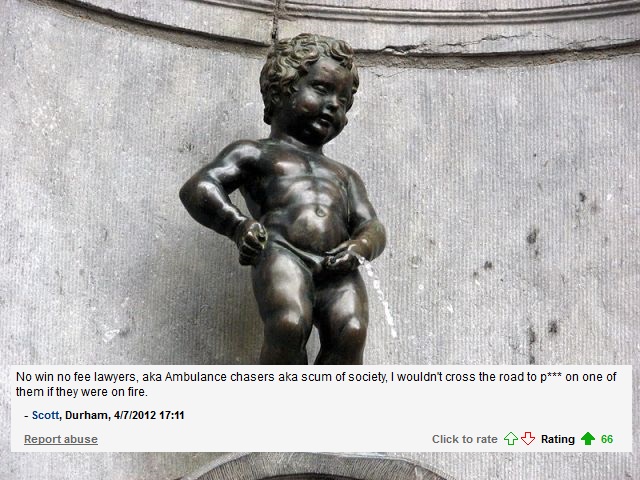
Lawyers: not even worthy of being pissed on.
mail-urinate
Lawyer roadkill
mail-hedgehog
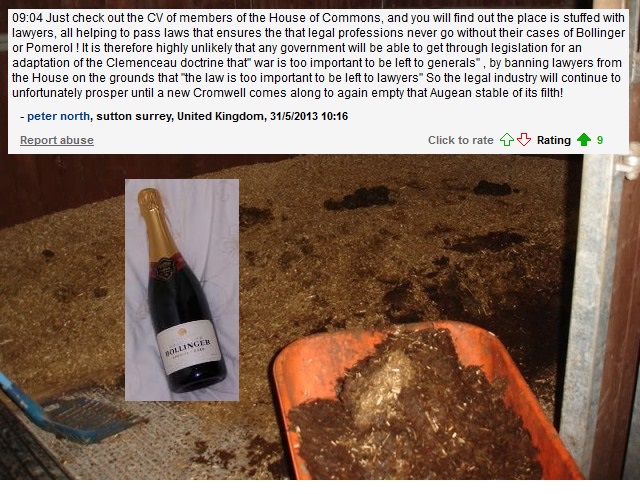
Filth and Bollinger
mail-stable
A solution to the Bollinger problem
tax-comment

Sunday, June 30, 2013

Law Society proposes code of conduct for will writing

Law Society proposes code of conduct for will writing

The Law Society is preparing to launch a voluntary code of conduct, aimed at members which are engaged in will writing, and following the Government’s decision to leave the practice unregulated.
The Government confirmed it would reject calls to regulate will writing earlier this month, against the recommendations of the Legal Services board.
The Law Society says it will respond to this inaction with the introduction of the Wills and Inheritance Scheme; a voluntary code of conduct which is open to members of the Law Society and will encourage firms to subscribe to a minimum set of standards when it comes to will writing.
Details of the scheme have yet to be confirmed but the society says it is aiming to have the majority of details in place by July and to start accepting applications by the end of October.
Under the draft proposals, firms which qualify for the scheme would become accredited for one year, after which the process would have to be renewed.
A spokeswoman for the Law Society says: “Until the Government changes its minds on this, the only sensible choice for consumers is to have a solicitor to write your will, and to ensure a solicitor is chosen to administer the estate of your loved one. A solicitor is qualified and brings the comfort of an unrivalled regulatory and compensation system to put right any errors.  
“The Law Society scheme, set to launch in July, will aim to set minimum practice standards for firms advising on will writing and estate administration. Firms will have to abide by key principles set out in a general protocol dealing with service levels, timescales for communications with clients, and transparency about costs.  
“The regulation of will-writers remains Law Society policy and we believe that it is strongly in the public interest.  We will be reviewing next steps in the light of the Lord Chancellor’s decision.”
The LSB, tasked with overseeing the UK’s legal regulators, said it was disappointed by the Government’s refusal to impose mandatory regulation and said it would examine the details of the decision before responding.
The Law Society said the decision had let down consumers and would leave unregulated providers free to carry on writing wholly unsuitable wills.

Monday, June 10, 2013

Sisters of the Earl of Durham launch court action over inheritance

Sisters of the Earl of Durham launch court action over inheritance


AN aristocrat from the North East has become embroiled in a legal fight with his three sisters over the fate of his multi-million pound inheritance.
Ned Lambton, the Earl of Durham, has fallen out with three of his five siblings over their attempts to claim a slice of the estate he inherited from his late father, the disgraced former Conservative minister Antony Lambton, in 2006.
Under British law the eldest male heir receives not only their parent’s title but also their entire estate – yet author and TV presenter Lady Lucinda Lambton, actress Lady Anne Lambton and Lady Beatrix Neville are hoping to apply Italian law, as the ex-defence minister lived there for nearly 30 years after being caught with a prostitute by the News of the World.
However, that would also include any assets the peer gave away during his lifetime – including the Grade II listed Lambton Castle, between Sunderland and Chester-le-Street, which is thought to be held in trust.
Now Lord Durham – who until recently had been negotiating with his sisters and their lawyers over the possibility of each receiving up to £1m in exchange for renouncing a much larger claim – has issued a High Court writ aimed at preventing the use of the foreign statutes.
The women’s lawyer, Ludovic de Walden, said the trio were “surprised” by the move, which “seems to have closed the door on what could have otherwise been a private and easily resolved family dispute”.
The High Court claim details how Lord Lambton made a will in 2004 – two years before his death – leaving his estate to his only son.
    
“None of the claimant’s sisters is mentioned in Lord Lambton’s will. No challenge to that will has ever been made,” the claim states.
The writ says the three sisters began legal proceedings of their own in September 2011 and that under Italian law all Lord Lambton’s assets should be included in the pot to be divided.
The seventh earl, whose previous wives include the current spouses of musician Jools Holland and actor Dominic West, is asking the High Court to declare that assets disposed prior to his father’s death do not form any part of his estate.
A spokesman for Lord Durham’s lawyers, Withers LLP, said: “Lord Lambton left everything at his death in 2006 to his only son Lord Durham, having already provided for his other children.”


Read more: Journal Live http://www.journallive.co.uk/north-east-news/todays-news/2013/05/20/61634-33354151/#ixzz2VoQjvDwq

Friday, May 3, 2013

Monday, March 18, 2013

Living on the dole and taking showers at public baths because he has no hot water: the life of the Earl of Cardigan after ex-wife leaves fortune to children

Living on the dole and taking showers at public baths because he has no hot water: the life of the Earl of Cardigan after ex-wife leaves fortune to children


1 / 1
Lord Cardigan in the derelict Tottenham House
Rex Features
Related articles
Relying on jobseeker's allowance when work as a delivery driver dries up, while living in an unheated house forces you to travel to local public baths for a shower, surely cannot be the kind of life one expects when born into aristocracy.
But for David Brudenell-Bruce, the Earl of Cardigan, that is exactly the life he faces every week, after a series of financial misfortunes befell him over the last few years.
Lord Cardigan, 60, went through a costly divorce and a much-publicised stint in rehab in the US, and has also faced angry legal confrontations with the trustees of his estate and a series of prosecutions for assault and criminal damage.
The most recent chapter in his financial downfall was revealed last week when probate records showed that his former wife, Lady Cardigan, who died shortly after the couple's divorce last year, left all of her £1,520,582 estate to her two children, excluding any mention of her ex-husband in the will.
The estranged couple's children are 27-year-old daughter, Bo (real name lady Catherine Brudenell-Bruce), who was the runner-up in BBC's The Voice, and Thomas, 30, neither of whom have any contact with the Earl.
Bo and Thomas still live at Leigh Hill House on the Savernake Estate - England's only privately-owned forest - which was left to their mother as part of the divorce settlement.
Meanwhile, the Earl and his new wife Joanne live in comparative poverty in an unheated house on the otherside of the estate, taking showers in public baths in nearby Marlborough.
The divorce settlement between is reported to have cost the Earl about £2m and forced the trustees of his estate to sell valuable portraits by high profile artists, including Sir Peter Lely and Sir Joshua Reynolds, leading to further legal costs as the Earl battled to keep the paintings.
According to The Times, while Lord Cardigan works as a delivery driver, transporting goods from Harrods to private jets at Heathrow Airport, in the weeks where there is insufficient work, his wife and he are forced to survive on £71-per-week jobseeker's allowance.
Between the Earl's and his children's homes lays Tottenham House, a derelict building whose past occupant was another Lord Cardigan, a distant relative who led the Charge of the Light Brigade in the Crimean War.
The present Earl went to the prep school that occupied Tottenham House before going to agricultural college so that his father could leave the running of the estate in his son's hands while he worked as a stockbroker in the city.
In 2005 it looked as though the family's fortunes were taking a turn upwards as a deal was secured to turn the old house into a hotel, but this fell through when the credit crunch hit.
Officially, the Earl owns 49 per cent of the estate on paper but two trustees have overall control. A High Court hearing resumes later this year in which the Earl will contest the control of the estate.

http://www.independent.co.uk/news/people/news/living-on-the-dole-and-taking-showers-at-public-baths-because-he-has-no-hot-water-the-life-of-the-earl-of-cardigan-after-exwife-leaves-fortune-to-children-8524565.html